
The lead qualification questions that actually work come down to five: why now, who signs off, can they pay, what's the timeline, and what happens if they do nothing. Ask those five well and you'll cut through most of the noise in your pipeline before you burn an hour on a discovery call that goes nowhere.
Here's the short list to memorize before your next call:
- "What prompted you to look into this now?" — surfaces the trigger event or confirms there isn't one
- "Who else needs to sign off on this decision?" — exposes the real buying committee
- "Is there budget allocated, or would this need a business case?" — tests financial reality without sounding like an interrogation
- "What's driving your timeline?" — separates a real deadline from a vague "sometime this year"
- "What happens if you don't solve this?" — measures actual pain versus casual curiosity
If a lead answers three or more of these with specifics, route it to a rep immediately. If the answers are vague across the board, nurture instead of chasing. Frameworks like BANT and MEDDIC formalize this same logic, and industry guidance on MQL-to-SQL conversion benchmarks backs up why the early filter matters so much. Trade businesses using an intake tool like Query Trade often bake these exact five questions into a shareable form, so the qualifying happens before the phone even rings.
Key Takeaways
Lead qualification works when a short, consistent set of trigger, authority, budget, and timeline questions gets asked the same way every time and routed against a shared scoring rubric.
| Point | Details |
|---|---|
| Ask the trigger question first | "What prompted you to look into this now?" reveals real urgency versus casual browsing. |
| Use a three-pillar score | Weight behavior, firmographic fit, and urgency, then route at 70+, 40-69, and below 40. |
| Rephrase budget questions | Ask if funding is allocated or needs approval instead of asking for a number directly. |
| Cap discovery calls at 4-6 questions | Pre-qualify through an intake form so the call confirms facts instead of collecting them. |
| Capture signals before contact | Query Trade's intake links gather urgency, photos, and job details before a rep ever calls back. |
Table of Contents
- What Are Lead Qualification Questions, Really?
- Why Rigorous Qualification Protects Your Pipeline
- Which Qualification Framework Fits Your Sales Motion?
- The Core Lead Qualification Questions, Grouped by Criterion
- How Do You Score and Prioritize Qualified Leads?
- What Goes Wrong When Qualifying Leads (And How to Fix It)
- A Discovery Call Script and Intake Form You Can Use Today
- Why "What Prompted You to Look Into This Now?" Works So Well
- Where Ethics and Legal Limits Apply to Qualification Questions
- How Long Should Lead Qualification Take, and What Should It Cost?
- Adjusting Lead Qualification Questions by Industry and Persona
- Training Your Sales Team to Ask Better Qualification Questions
- The Full Qualification Workflow, Start to Finish
- The Real Skill Isn't the Question List, It's the Delivery
- Capture Qualification Signals Before the Phone Even Rings
- Sources
What Are Lead Qualification Questions, Really?
Lead qualification is the process of deciding whether a lead deserves a rep's time right now. That's it. Not whether they're nice, not whether they filled out a form politely. Whether pursuing them today is a good use of a limited resource: your sales team's attention.
Every qualification conversation should end in one of three outcomes:
- Pursue — the lead has need, authority, budget reality, and a timeline. Hand it to a rep now.
- Nurture — some signals are there, but timing or authority isn't confirmed. Keep in a drip sequence.
- Disqualify — no real fit, no real urgency, or actively wrong for your product. Let it go.
People often confuse qualification with lead scoring, but they're not the same thing. Scoring is the mechanism, points assigned for behavior, firmographics, and intent. Qualification is the decision that mechanism supports. A score tells you a lead is "hot." Qualification is what you do because of that score.
This is exactly where an intake form earns its keep. Instead of guessing at fit during a live call, a shareable link, the kind Query Trade builds for tradespeople handling customer inquiries, can ask for the job type, urgency, and budget status before a single word is exchanged over the phone.
Why Rigorous Qualification Protects Your Pipeline
Poor qualification is expensive in ways that don't show up on a dashboard until it's too late. A rep who spends three hours a week on leads that were never going to close isn't just wasting time, they're not spending that time on leads that would.
Weak qualification costs you:
- Wasted rep hours on prospects who were never going to buy
- Slower sales velocity because forecasts get clogged with dead weight
- Lower morale, since reps start distrusting the leads they're handed
- Missed real opportunities, because attention got spent in the wrong place
Good qualification delivers the inverse: faster cycles, higher win rates, and reps who trust their pipeline enough to prioritize confidently.
Where the industry sets the bar: guidance on lead qualification for 2026 recommends keeping discovery calls to just 4 to 6 qualification questions, since pre-qualifying before the call means those questions confirm facts rather than collect them from scratch. That's a meaningful shift from the old model of a rep fishing for information live on the phone.
The operational fix is boring but effective: standard rubrics, a short intake form, and enough automation that the signals get captured the moment a lead appears rather than three follow-up emails later. A tool like Query Trade shortens that gap by routing inquiry details straight into a pipeline the moment someone submits a job request, cutting the time between "lead appears" and "rep sees the full picture" down to minutes.
Which Qualification Framework Fits Your Sales Motion?
Not every deal needs the same qualification depth. A $200 job and a $200,000 enterprise contract shouldn't go through the same set of questions, and trying to force one framework onto every deal type is how qualification programs collapse under their own weight.
Four frameworks cover almost every situation:
BANT (Budget, Authority, Need, Timeline) is the oldest and simplest. It fits transactional deals with short cycles and a single decision-maker, think small trade jobs or SMB software purchases.
MEDDIC (Metrics, Economic Buyer, Decision Criteria, Decision Process, Identify Pain, Champion) is built for complexity. Multiple stakeholders, long cycles, procurement involvement. It forces you to map the committee, not just one contact.
CHAMP (Challenges, Authority, Money, Prioritization) leads with the prospect's problem before touching budget or authority, useful when pain isn't obvious upfront and needs surfacing first.
GPCTBA/C&I (Goals, Plans, Challenges, Timeline, Budget, Authority, Consequences, Implications) is the most consultative, built for solution-selling where the conversation is as much about outcomes as it is about the product.
| Framework | Best fit | Typical cycle length |
|---|---|---|
| BANT | Transactional, single decision-maker | Days to a few weeks |
| MEDDIC | Enterprise, multiple stakeholders | Months |
| CHAMP | Pain-first conversations | Weeks to months |
| GPCTBA/C&I | Consultative, outcome-based selling | Months |
Selecting a framework comes down to deal size, stakeholder count, and cycle length, exactly the logic laid out in guidance on choosing qualification frameworks by context: BANT for short transactional deals, MEDDIC for enterprise, GPCTBA/C&I for consultative buys.
Pro Tip: Don't force a single framework on your entire funnel. Use a lightweight upstream filter (three or four fast questions) to handle volume, then switch to MEDDIC-style mapping only once a lead clears that first bar and looks like a real opportunity.
For trades businesses fielding dozens of small job inquiries a week, this hybrid approach matters more than picking the "correct" framework. Query Trade's intake links act as that upstream filter, screening job type and urgency before a tradesperson decides which inquiries deserve a callback first.
The Core Lead Qualification Questions, Grouped by Criterion
This is the part you'll actually use on your next call. Six criteria, each with the questions that extract a real answer instead of a polite non-answer.
Need and pain
- What's the specific problem you're trying to solve?
- How are you handling this today, and what's not working?
- What made this problem worth solving now instead of six months ago?
- Who else on your team feels this pain, or is it just you?
- What have you already tried that didn't work?
- If this problem stays unsolved for another quarter, what does that cost you?
Follow-up probe: "Can you walk me through the last time this went wrong?" Specifics beat generalities every time.
Urgency and trigger
- What prompted you to look into this now?
- Is there a deadline driving this, or is it more exploratory?
- What changed recently that made this a priority?
- Are you evaluating other options at the same time?
Follow-up probe: "What happens on your end if this isn't resolved by [their stated deadline]?"
Budget
- Is there budget already allocated for this, or would you need to build a business case?
- What have you budgeted for solutions like this in the past?
- Who approves spend at this level?
Phrasing here matters more than in any other category. Guidance on phrasing budget questions recommends asking whether budget is already allocated or a business case is required, rather than the blunt "what's your budget?", since the direct version tends to trigger defensiveness and vague, unusable answers.
Authority and decision process
- Who else is involved in making this decision?
- Walk me through how a decision like this typically gets made at your company.
- Has anyone tried to solve this before and hit resistance internally?
Follow-up probe: "If I sent over a proposal today, who would need to see it?"
Timeline and implementation
- When would you want this up and running?
- Is that date tied to something specific, or is it a soft target?
- What would need to happen on your end before you could move forward?
Fit and constraints
- What does your current setup look like?
- Are there any technical, budget, or policy constraints I should know about upfront?
- Have you worked with a provider like us before? What worked or didn't?
Pro Tip: Push the fit and firmographic questions into your intake form, not the call. Save your live conversation time for pain, authority, and urgency, the things a form can't reliably capture on its own.
Most of the firmographic and fit questions belong on an intake form, not a live call. That's precisely the gap Query Trade's shareable intake link closes: a tradesperson gets job type, photos, and urgency answered before they even pick up the phone.
How Do You Score and Prioritize Qualified Leads?
A scoring rubric turns "this feels like a good lead" into a number your whole team agrees on. The simplest reliable model weights three pillars: behavior, firmographic fit, and urgency.
A composite model that blends behavioral signals, firmographic fit, and intent data into one score, then routes leads by tier, is a practical starting point for most teams. Behavioral signals, demo requests, repeat visits, pricing page views, should generally carry more weight than static firmographics when you're trying to catch short-term buying intent.
| Score range | Tier | Action |
|---|---|---|
| Top tier | SQL | Route directly to a sales rep |
| Middle tier | MQL | Active nurture sequence |
| Lower tier | Unqualified | Long-cycle nurture or suppress |
Two quick examples show how this plays out. A lead with a high firmographic fit (right company size, right industry) but low urgency, no trigger event, vague timeline, should sit in the 40 to 69 range and go to nurture, not straight to a rep. Flip it: a lead with high urgency (a stated deadline, a clear trigger) but a mediocre firmographic fit might still clear 70 if the pain is real and immediate. Urgency often outweighs textbook fit.
- Assign point values to each pillar (behavior, fit, urgency) based on your closed-deal history.
- Set your three tier thresholds and document the action for each.
- Route automatically where possible, manual triage doesn't scale past a handful of leads a week.
- Recalibrate thresholds after 60 to 90 days once you have enough closed deals to check your assumptions.
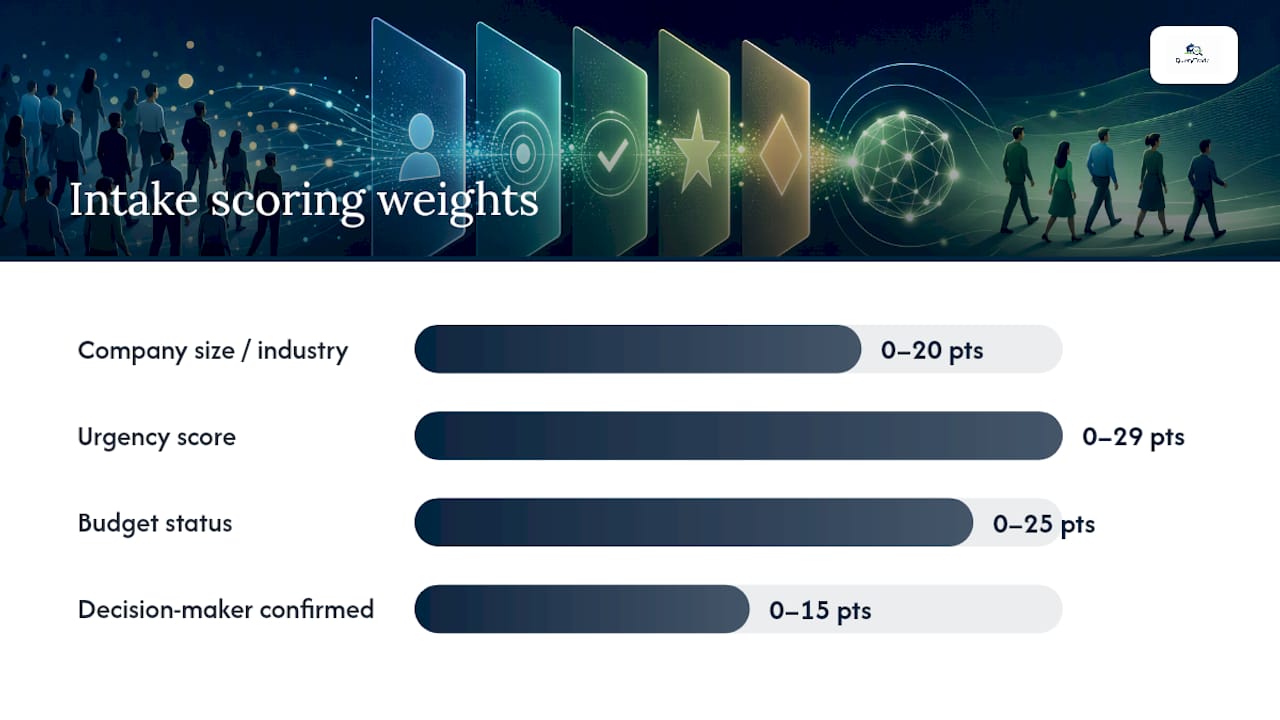
Adding required fields to your intake process, urgency score, budget status, decision-maker confirmation, makes this rubric enforceable rather than aspirational. Query Trade's pipeline stages (New, Contacted, Quoted, Scheduled, Completed) mirror this exact tiering logic, so a job inquiry's urgency ranking is visible the moment it lands rather than buried in an inbox.
What Goes Wrong When Qualifying Leads (And How to Fix It)
Five problems account for most bad qualification calls:
- Surface-level answers. The lead says "we're just exploring options" and the rep moves on without probing.
- No real authority. The person on the call sounds enthusiastic but can't actually approve spend.
- Vague timelines. "Sometime this year" isn't a timeline, it's a stall.
- Inflated budgets. Prospects sometimes overstate budget to keep a conversation going, then stall at the proposal stage.
- Committee inertia. Multiple stakeholders exist, but nobody's actually driving the decision forward.
Each has a script that turns a mushy answer into something you can act on:
Surface-level answer: "When you say you're exploring options, is there a specific event that triggered that, or is this more of a background project right now?"
No confirmed authority: "Totally understand you're gathering info. Who typically signs off once you've narrowed it down?"
Vague timeline: "Is 'this year' tied to a budget cycle, a contract renewal, or something else driving the date?"
Writing disqualifiers into your rubric, not just qualifiers, keeps weak leads out of the pipeline in the first place rather than relying on reps to catch them late. That's the logic behind building explicit disqualification rules into a scoring model instead of treating qualification as a funnel-widening exercise.
Pro Tip: When you disqualify politely, leave the door open: "This doesn't sound like the right fit for right now, but I'd love to check back in a few months if things change." That single line keeps a dead lead nurturable instead of burned.
Requiring a decision-maker field and an urgency score on your intake form forces this consistency across the whole team, not just your best rep. Query Trade's required fields do this by default, so no inquiry slips through without the basics a tradesperson needs to triage it.
A Discovery Call Script and Intake Form You Can Use Today
Here's a workable structure for the first 20 minutes of a discovery call, built around confirming facts rather than collecting them cold.
Minutes 0 to 10:
- Open with context: "Before we dive in, tell me what prompted you to reach out."
- Confirm the pain: "What's not working with your current approach?"
- Test urgency: "Is there a specific deadline driving this?"
Minutes 10 to 20: 4. Map authority: "Who else would be involved in this decision?" 5. Test budget reality: "Is there budget set aside, or would this need a business case?" 6. Confirm timeline: "If we moved forward, when would you want this live?"
That's six questions total, in line with the 4 to 6 question guideline that keeps a discovery call from turning into an interrogation.
An intake form should collect the facts a rep shouldn't have to ask live:
| Intake field | Scoring points | Routing action |
|---|---|---|
| Company size / industry fit | 0-20 | Firmographic pillar |
| Urgency score (1-10) | 0-29 | Urgency pillar |
| Budget status (allocated / needs approval) | 0-25 | Budget pillar |
| Decision-maker confirmed (yes/no) | 0-15 | Authority pillar |
| One-line problem statement | Qualitative | Rep review |
Your follow-up email should include a short checklist: confirm the trigger event, confirm the decision-maker, confirm budget status. Qualified leads move to a proposal stage; disqualified ones get a polite note and a nurture tag.
This is close to exactly what Query Trade's intake link and photo upload feature handle automatically, capturing job type, urgency, and problem description before a tradesperson ever calls back, so the call itself becomes a confirmation, not a fishing expedition.
Why "What Prompted You to Look Into This Now?" Works So Well
Every framework in this guide points back to one question that outperforms the rest: "What prompted you to look into this now?"
Asking about the trigger event uncovers whether a lead has a real, dated reason for reaching out, or whether they're just browsing. That single answer reliably separates high-intent prospects from casual researchers far better than any budget or authority question on its own.
A workflow example makes this concrete. Say a tradesperson gets two inquiries the same day. One says: "Looking for a quote sometime, just comparing." The other says: "Our boiler failed last night and we have guests arriving Friday." Same job type, wildly different urgency. Without a structured way to capture that trigger narrative, both land in the inbox looking identical.
Pre-contact qualification based on observable signals scales far better than trying to establish urgency by phone across a long list of inquiries, since you can't call every lead just to find out which ones actually matter.
Pro Tip: Add one required field to your intake form: a short trigger narrative or a simple checkbox ("urgent / planning ahead / just researching"). It costs nothing to add and does more filtering than five extra phone questions.
That's exactly the field Query Trade builds into its intake links, capturing the trigger narrative before a job request even reaches the pipeline, no extra software or technical setup required.
Where Ethics and Legal Limits Apply to Qualification Questions
Qualification questions can drift into uncomfortable territory if you're not careful, and a few categories deserve explicit caution.
Avoid questions that probe protected characteristics unrelated to the buying decision, age, family status, health, unless they're directly relevant to the product itself. Budget questions should stay focused on the business's ability to pay, not personal financial pressure tactics. If you operate in regulated industries (financial services, healthcare, legal), your qualification questions may also need to respect industry-specific disclosure rules, since some of what you ask or record can carry compliance obligations depending on your sector.
Transparency matters too. If you're capturing data through an intake form, make it clear what happens to that information and don't collect more than you need to make a routing decision. A short, honest intake form builds more trust than a long one that feels like an interrogation, and it protects you from data you can't justify holding.
This is general guidance, not legal advice. If your qualification process touches regulated data or industry-specific disclosure rules, confirm the current requirements with a qualified professional in your jurisdiction.
How Long Should Lead Qualification Take, and What Should It Cost?
Qualification itself, the actual back-and-forth, should take minutes, not days. If your intake form captures firmographics, urgency, and a problem statement upfront, a rep should be able to confirm fit in a single 15 to 20 minute call.
The bottleneck usually isn't the questions, it's the gap between when a lead submits an inquiry and when someone actually reviews it. A lead that sits unread for two days has often already contacted three competitors. Cutting that time-to-first-touch matters more for conversion than any single question on your script.
On budget questions specifically, don't ask for a dollar figure on the first contact if you can avoid it. Ask whether funding is already approved or whether the prospect needs to build an internal case, since that phrasing tells you far more about deal speed than a raw number would. A prospect with approved budget moves in weeks; one building a business case internally may take months, regardless of how enthusiastic they sound on the call.
Query Trade shortens the time-to-first-touch problem directly: the moment a job inquiry lands through an intake link, it's visible in the pipeline with photos and urgency ranking attached, no digging through email threads to find the details.
Adjusting Lead Qualification Questions by Industry and Persona
The five core questions hold across industries, but the phrasing and priority shift depending on who's on the other end of the conversation.
For a software buyer, authority questions matter most early, procurement processes and multiple stakeholders are the norm, so mapping the committee (MEDDIC-style) pays off fast. For a local service business, urgency usually dominates: "when did this break" matters more than "who else needs to approve this," since most decisions rest with one person.
Persona also shapes tone. A technical buyer wants specificity, ask about their current stack or process in detail. A non-technical buyer, common in trades and small business contexts, responds better to plain outcome-focused questions: "what would this fix for you" rather than "what's your current architecture."
For trades businesses specifically, the "budget" question often becomes "is this an emergency or can it wait," and "authority" often simplifies to "are you the homeowner or managing this on someone else's behalf." Query Trade's intake forms adapt by trade, a painter's form asks about square footage and surface type, while a builder's form might ask about permits and site access, so the qualification questions match the actual job rather than a generic template.
Training Your Sales Team to Ask Better Qualification Questions
The gap between a rep who qualifies well and one who doesn't usually isn't talent, it's repetition. Reps who've internalized four to six core questions ask them naturally, in the flow of conversation, instead of reading off a script.
Effective training focuses on a few things: role-playing real objections (not just reciting the question list), reviewing recorded calls to spot where a rep accepted a vague answer instead of probing further, and building a shared vocabulary so "qualified" means the same thing to every rep on the team. Consistency in required CRM fields matters here too, if one rep logs urgency and another doesn't, your scoring rubric breaks down at the reporting stage.
New reps often over-rely on rigid scripts, which can come across as robotic. The fix isn't fewer questions, it's better phrasing, teaching reps to ask the same six questions as if they're genuinely curious rather than checking boxes.
The Full Qualification Workflow, Start to Finish
Qualification isn't a single moment, it's a sequence. Here's how the pieces fit together from first contact to handoff:
Identify the lead source and initial signal (form fill, inquiry, referral). Research available firmographic and behavioral data before any contact happens. Ask the core qualification questions, live or via intake form. Score the lead against your rubric (behavior, fit, urgency). Prioritize based on tier, SQL, MQL, or unqualified. Nurture or disqualify leads that don't clear the bar for immediate sales attention. Handoff qualified leads to a rep with full context already attached, no re-asking questions the intake form already answered.
The workflow breaks down most often at the handoff stage, a rep gets a "qualified" lead with no context and has to start the conversation from zero anyway. Building intake and pipeline tools that carry data forward automatically, rather than relying on a rep to manually transcribe notes, is what makes the whole sequence actually work in practice.
The Real Skill Isn't the Question List, It's the Delivery
Every framework in this guide, BANT, MEDDIC, CHAMP, works on paper. What separates a rep who closes consistently from one who doesn't is rarely which framework they memorized. It's whether their questions sound like curiosity or like a form being read aloud.
Take a blunt version of a qualification question: "What's your budget?" It's direct, but it puts a prospect on the defensive almost immediately. Now compare it to: "Have you already got budget set aside for something like this, or would this need to go through an approval process?" Same information. Completely different feel. The second version invites a real answer because it acknowledges that budget approval is a process, not a confession.
The best reps treat qualification questions as genuine curiosity about the prospect's situation, not a checklist to clear before pitching. That mindset shift, from extracting information to understanding a problem, is what makes a prospect open up about the real trigger behind their inquiry instead of giving a guarded, generic answer.
Train your team to practice four to six core questions until the phrasing feels natural, not memorized. Then use your intake data, whether that's from a CRM or a tool like Query Trade, to check whether the questions reps are asking live actually match what the form already told them. If there's a mismatch, that's your training gap.
Capture Qualification Signals Before the Phone Even Rings
Every question in this guide works better when you're not asking it cold. Query Trade's shareable intake link collects the job type, photos, urgency ranking, and problem description the moment a customer submits an inquiry, so a tradesperson walks into every call already knowing whether it's worth taking.
Required fields mean no inquiry slips through without the basics: what the job is, how urgent it is, and what the customer actually needs. The job pipeline then sorts everything into stages, New, Contacted, Quoted, Scheduled, Completed, so prioritizing a genuine emergency over a "just browsing" inquiry takes seconds, not a full read-through of your inbox. Automated notifications mean nothing sits unread for two days while a competitor calls back first.
This isn't about replacing the questions in this guide, it's about answering most of them before the conversation starts. Set up an intake link, add your required fields, and see how much faster qualification moves when the groundwork is already done. Check the full feature set and get your intake link live in under five minutes.
Sources
These sources shaped the frameworks, scripts, and scoring guidance covered above:
- Lead Qualification Guide: How to Qualify Prospects in 2026
- Lead Qualification: How to move qualification upstream in 2026
- Lead Qualification Framework 2026: Behavioral + AI Scoring
- 20 Essential Lead Qualification Questions Every B2B Sales Rep Should Ask in 2026
- Lead Qualifying Questions: 25 Questions That Separate Buyers From Time-Wasters
Read through these, then test one small change this week: add a single required trigger-narrative field to whatever intake process you're using now, and watch how much easier prioritization gets.