
A quote is a fixed price that becomes a binding offer the moment your customer accepts it. An estimate is an educated guess, not a promise, and it can shift as the real scope of the job comes into focus. Get that one distinction backward, and you're the one paying the difference out of pocket.
The choice between the two comes down to how much you actually know about the job:
- Ask for or issue an estimate when the site hasn't been inspected, the scope is still moving, or the client hasn't finalized specs.
- Insist on a quote when the work is fully scoped, the price is significant, or the client needs a fixed number to get budget approval.
Consumer-protection guidance from sources like Nibusinessinfo treats a labeled, single-total document as binding on the tradesperson who issued it. The Dispute Resolution Ombudsman puts it more simply: use estimates early, quotes once you know exactly what you're pricing, and keep both in writing.
Key Takeaways
A quote is a fixed price that binds you once accepted, while an estimate is a non-binding approximation that should be revised as scope becomes clear.
| Point | Details |
|---|---|
| Label documents accurately | Use "quote" only for a fixed, binding total; use "estimate" for approximate, non-final figures. |
| Put everything in writing | Verbal numbers create disputes; written documents with clear terms protect both parties. |
| Convert estimates once scope is firm | Move from estimate to quote after a site visit or full specs, not before. |
| Document every variation | Get written sign-off before extra work begins to avoid overrun disputes. |
| Use a tracking tool | QueryTrade's pipeline and deposit collection keep quote status and acceptance records organized. |
Table of Contents
- What Is an Estimate in Business?
- What Is a Quote in Business?
- Quote vs Estimate: The Key Differences
- When to Ask for an Estimate vs When to Insist on a Quote
- How the Law Treats Quotes vs Estimates
- What Every Written Quote or Estimate Should Include
- What Happens When the Final Cost Changes
- A Simple Workflow: How Tradespeople Win Work and Avoid Disputes
- Why Clear Labeling Beats Clever Wording
- Make Quoting and Estimating Faster With QueryTrade
- Sources
What Is an Estimate in Business?
An estimate is a non-binding, best-guess price based on the information available at the time. It's not a contract offer. It's a forecast, and forecasts miss.
You'll usually see estimates carrying hedge language: "approximate," "in the region of," "subject to survey," or a range like $2,000 to $2,500 rather than a single figure. That wording isn't sloppy drafting. It's doing real legal work, signaling to the customer that the number can move once the job is better understood.
Picture an upholsterer quoting a client over the phone: "recovering a three-seat sofa in a mid-range fabric usually runs $600 to $900, but I'll confirm once I've seen the frame condition and measured the fabric needed." That's a textbook estimate. The final price depends on facts the upholsterer can't see yet: hidden frame damage, extra foam needed, whether the fabric pattern requires match-cutting that eats more yardage.
Estimates carry real risk if handled carelessly. A tradesperson who lowballs an estimate to win the job, then hits the customer with a bill twice the size, is asking for a dispute and possibly a bad review. An estimate still has to be a genuine, reasonable attempt at the likely cost, documented well enough that you can defend the number if it's challenged later.
What Is a Quote in Business?
A quote, also called a quotation, is a fixed-price offer. Once your customer accepts it, you generally can't unilaterally raise the price for the scope you quoted, according to research from Cashflowdesk. That's the entire point of issuing one: certainty, in exchange for you carrying the pricing risk.
A properly written quote includes:
- A single total price, not a range.
- Itemized line items showing labor, materials, and any subcontracted work.
- A validity period (commonly 30 days), after which the price can be revised.
- Payment terms and any deposit required before work starts.
- Exclusions and a variation clause covering what happens if the customer changes their mind mid-job.
Wording matters more than most people realize. Compare "estimated cost: $4,200" against "quotation: total fixed price $4,200, valid for 30 days from the date of this document, excludes electrical certification." The second version reads as an offer with clear terms, exactly the kind of document that squote's legal analysis says courts are likely to treat as binding.
Only issue a quote once you've actually seen the job. A carpenter pricing a fitted wardrobe should measure the room, check for uneven walls or floors, and confirm the client's material choice before committing to a number. Quoting blind and hoping the site matches the brief is how tradespeople end up eating costs they never priced for.
Quote vs Estimate: The Key Differences
| Factor | Estimate | Quote |
|---|---|---|
| Binding nature | Non-binding, approximate | Binding once accepted |
| Price precision | Range or rough figure | Single fixed total |
| When to use | Early stage, unknowns remain | Scope finalized, full specs known |
| Validity period | Often informal, no fixed expiry | Usually stated (commonly 30 days) |
| Handling changes | Price can move as details firm up | Requires a formal variation or change order |
| Typical wording | "Approximate," "in the region of," ranges | "Fixed price," "valid until," itemized total |
For the customer, an estimate buys flexibility but risks a surprise final bill. A quote buys budget certainty but locks them into the agreed scope, meaning any change they request later usually costs extra.
For the tradesperson, an estimate protects against pricing a job you haven't fully assessed. A quote protects your margin only if you scoped the job correctly the first time. Get the site visit wrong and a fixed quote turns into a loss-making job with no way to recover the difference.
The trade-off, at its core, is certainty versus flexibility. Nobody gets both.
When to Ask for an Estimate vs When to Insist on a Quote
The rule of thumb from TradeQuoteAI is simple: can you commit to the number today? If yes, quote it. If not, estimate it and say why.
Signals that point toward an estimate:
- Site conditions are unknown, such as a renovation where you can't see behind existing walls.
- The client hasn't decided on final specs, like tile choice or fixture brand.
- The work is billed hourly rather than by fixed scope, common for repair callouts.
- It's a first conversation and no site visit has happened yet.
Signals that point toward a quote:
- The scope, materials, and labor are fully specified and unlikely to change.
- The job involves a large sum where the customer needs a fixed number for a loan or budget sign-off.
- You've already done a site visit or received complete architectural drawings.
- The client explicitly asks for a firm price before agreeing to proceed.
Landscapers deal with this constantly. Ground conditions, drainage issues, and root systems are often invisible until digging starts, which is why most landscaping jobs begin as estimates before firming up into a quote once the site has been walked and tested.
Pro Tip: Move an estimate to a quote by gathering three things: exact measurements, confirmed material specs, and a completed site inspection. Once you have all three, rewrite the document with a single total, a validity date, and a variation clause, and relabel it "Quotation."
How the Law Treats Quotes vs Estimates
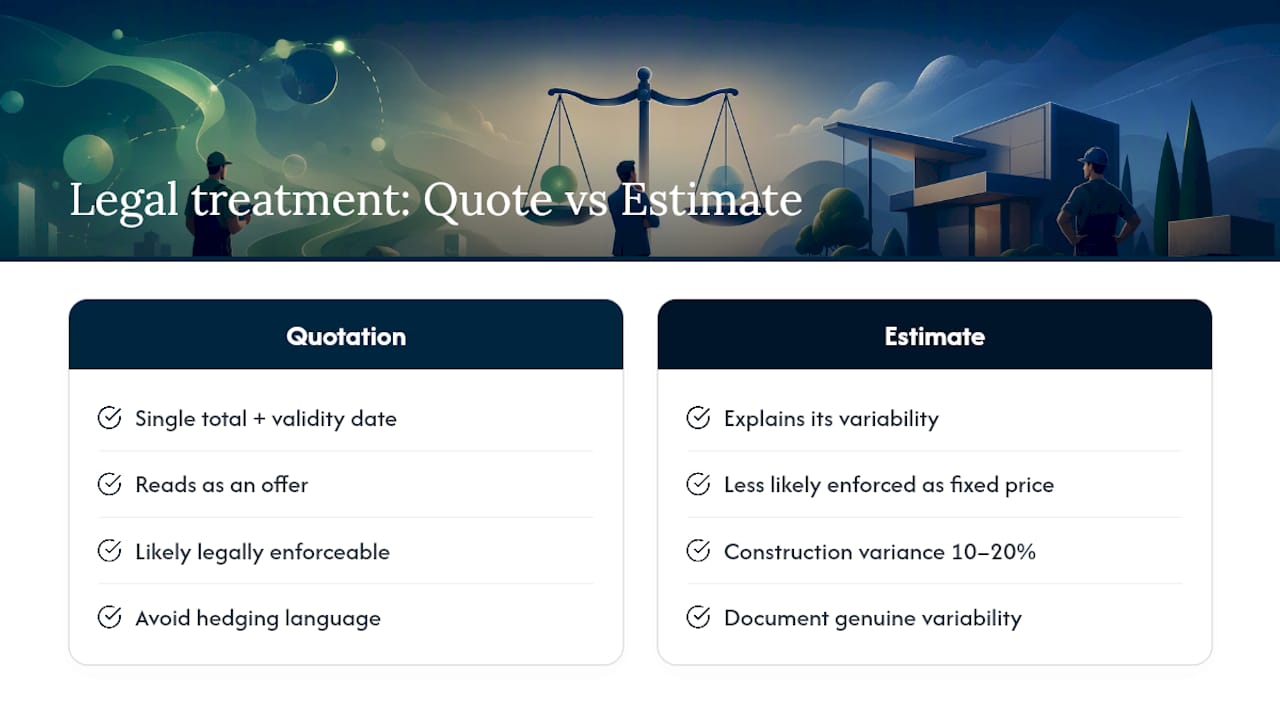
Wording carries legal weight, not just professional courtesy. A document titled "Quotation" that states a single total and a validity date reads as an offer capable of acceptance, and that's how squote's legal breakdown says courts are likely to treat it. A document titled "Estimate" that explains its own variability is far less likely to be enforced as a fixed price, provided the variability is genuine and documented.
Consumer-protection guidance leans toward the customer when the wording is ambiguous. Mix quote language with estimate-style hedging, and disputes are often resolved in the consumer's favor, according to Nibusinessinfo. If your document says "quote" but also says "prices may vary," you've created exactly the kind of confusion that authorities and ombudsmen exist to untangle.
Most disputes trace back to the same three failures: an ambiguous title, a missing scope of works, or hidden costs that surface after the job starts. None of these require bad faith. They happen because a tradesperson sent a quick text message instead of a proper document.
The difference between a quote and an estimate isn't academic. It's the line between a legally enforceable price and a starting point for negotiation, and mislabeling one as the other creates real legal exposure for whoever wrote it.
Construction work tends to see the widest gap between estimate and final cost, sometimes 10% to 20%, because hidden conditions and provisional sums are common on renovation projects. That's a normal range for an honest estimate. It's not an excuse to lowball a number you know is unrealistic just to win the job.
Pro Tip: Never use "estimate" and "quote" interchangeably in the same document or the same conversation. Pick one word, define what it means in writing, and use it consistently from first contact through final invoice.
What Every Written Quote or Estimate Should Include
A usable document, whether you're calling it a quote or an estimate, needs the same backbone. The difference is how tightly each section is locked down.
- Line-by-line breakdown: labor, materials, and any subcontracted costs listed separately, not bundled into one number.
- Scope of works: exactly what's being done, in plain language a non-tradesperson can follow.
- Assumptions: what you're taking for granted, such as "assumes standard 2x4 stud walls" or "assumes existing plumbing is code-compliant."
- Exclusions: what's explicitly not covered, like scaffolding, skip hire, or permit fees.
- Validity period: how long the price stands before it needs revisiting.
- Payment terms and deposit: amount due upfront, payment schedule, and final payment trigger.
- Variation procedure: how changes get priced and approved once work has started.
- Acceptance method: signature, email confirmation, or a digital form that timestamps agreement.
An estimate needs enough detail to be defensible if challenged, but it can carry looser language: "assumes no structural issues found behind existing plaster." A quote needs that same assumption locked down as a stated exclusion, with a clear note that discovering structural issues triggers a separate variation quote before work continues.
A quote without a scope of works is just a number with no boundaries, and numbers with no boundaries are exactly what disputes are made of.
What Happens When the Final Cost Changes
Costs shift. What separates a professional job from a dispute is whether the shift was documented before the extra work happened or discovered afterward on the invoice.
The standard process is a change order: a short written note describing the new work, its added cost, and a space for the customer to approve it before you proceed. No sign-off, no extra charge, full stop. This single habit prevents the majority of quote-related disputes tradespeople run into.
If a customer disputes an overrun anyway, the escalation path is straightforward:
- Pull the original document and confirm what was labeled "estimate" versus "quote."
- Show the specific assumption or exclusion that the overrun falls outside of.
- Offer an independent assessment if the customer disputes the extra work was necessary.
- Escalate to a dispute resolution body if the two of you can't reach agreement directly.
Silence past that point is what turns a reasonable overrun into a formal complaint.*
A Simple Workflow: How Tradespeople Win Work and Avoid Disputes
The tradespeople who avoid quote disputes almost always follow the same sequence: initial estimate, site visit, firm quote, written acceptance, then documented variations if anything changes.

Photos do a lot of the heavy lifting in that second step. A photo upload feature lets a customer send images of the job site before you've even scheduled a visit, which means you can convert a rough estimate into a firmer number faster, sometimes without driving out at all for smaller jobs.
Templates matter just as much as photos. A painter using the same quote template for every job, with the same line items, exclusions, and validity wording, builds trust because customers see consistency. That consistency is also what carpenters rely on when quoting kitchen fit-outs, where measurements and material specs need to be locked in before a firm number goes out.
A deposit request at acceptance does double duty. It confirms the customer is serious, and it gives you a paper trail showing exactly when and how the quote was accepted. Keep a short audit trail for every job: who approved which price, on what date, and what the confirmed total was. When a dispute does surface months later, that trail is the difference between a five-minute conversation and a drawn-out argument.
For guidance on how contractor websites should frame quote requests and manage customer expectations before work even starts, ForgeWeb Studio's contractor marketing guide covers the presentation side of this problem well.
Why Clear Labeling Beats Clever Wording
Most quote disputes I've seen unpacked come down to one root cause: somebody used the word "quote" loosely, meaning something closer to "rough idea," and the customer took it literally. The fix isn't cleverer legal wording. It's just calling things what they are, consistently, from the first phone call.
If I were pricing a high-value job tomorrow, here's the sequence I'd follow without exception:
- Inspect the site in person before writing anything down.
- Itemize every material and labor cost separately, even if the customer only wants to see one number.
- Issue a quote with a stated validity period, not an open-ended offer.
- Get written acceptance before touching a tool.
The trades that get burned aren't usually the ones doing shoddy work. They're the ones who skip the paperwork step because it feels like friction on a job they're eager to start. That friction is what protects both sides when memory gets fuzzy three months later.
Make Quoting and Estimating Faster With QueryTrade
Manually tracking which customers got an estimate, which got a firm quote, and which ones actually accepted is where most of these disputes are born, not in the pricing itself. QueryTrade's job pipeline tracks every enquiry from first contact through New, Contacted, Quoted, Scheduled, and Completed, so nothing sits in a gray area between "rough idea" and "confirmed job."

A shareable intake form captures the job details, photos, and urgency upfront, giving you what you need to skip a wasted site visit and go straight to a firm quote. Deposit collection through Stripe locks in acceptance the moment a customer confirms, creating the exact paper trail this article has been building toward. Say a painter gets an inquiry through the intake form with photos of a peeling exterior. Instead of a back-and-forth over text guessing at square footage, they issue a firm quote with a validity period the same day, and the deposit request confirms acceptance in writing.
Check the features overview to see the full workflow, or look at pricing to start a free 30-day trial and see how it handles your next job inquiry.
Sources
- Difference between a quotation and an estimate
- Q: What is the difference between and estimate and a quotation and why is it important? - Dispute Resolution Ombudsman
- What Is the Difference Between a Quote and an Estimate?
- Quote vs estimate: What's the difference when pricing up your build? | Homebuilding
- Quotes vs Estimates: Legal Differences UK | squote
- Difference Between a Quote and an Estimate UK (2026) — With Examples - TradeQuoteAI
Rules on binding contracts and consumer protection vary by jurisdiction, so confirm the specific requirements that apply where you operate, or consult a qualified professional before relying on this guidance for a high-value dispute.
What's the main difference between a quote and an estimate? A quote is a fixed price that becomes binding once the customer accepts it. An estimate is an approximate figure that can change once the job's full scope is known.
Is an estimate legally binding? Generally, no. An estimate is treated as a reasonable approximation, not a fixed offer, as long as it's clearly labeled and genuinely reflects the information available at the time.
Can a quote change after it's accepted? Only through a documented variation or change order that the customer agrees to in writing. Unauthorized price increases on an accepted quote create real dispute risk.
How long should a quote stay valid? Most tradespeople set a 30-day validity period, after which material costs or availability may have shifted enough to require a revised price.
What should I do if the final cost is going to exceed the estimate? Contact the customer before doing the extra work, explain what changed, and get written approval for the new cost. Silence until the invoice arrives is what turns a normal overrun into a formal complaint.